
Deven Bryant: A Homecoming of His Own
By Jai Ahuja, USC Football Communications Student Assistant
10/1/2026
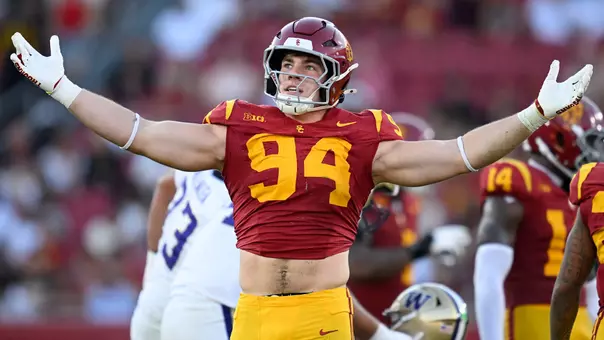
For Deven Bryant, USC’s Homecoming game carries an added layer of meaning.
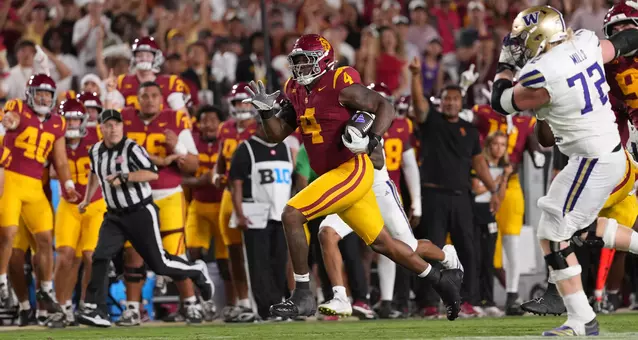
When the Trojans welcome Washington to the Coliseum, Bryant will line up against the program where his college career began. He arrived in Seattle as a young linebacker still trying to find his footing, learned from an experienced group of teammates and eventually earned a starting role of his own.
Now, he will face his former team while wearing the Cardinal and Gold of the program he grew up watching.
Bryant was raised in Carson, California, just a few miles from USC. His father was a Trojan fan, and Bryant remembers watching USC games alongside him. He later attended St. John Bosco High School, a program with a strong history of sending players to USC.
So, when the Trojans came calling through the transfer portal, Bryant did not need much convincing.
“It was kind of a no-brainer,” Bryant said. “This was the best spot and the best-case scenario for me.”
That straightforwardness is part of what defines Bryant. He is warm and easy to talk to, but carries himself with a quiet sense of purpose. He is not particularly interested in drawing attention to himself or looking too far ahead. Instead, he keeps his focus on what is in front of him and what needs to be done next.
That approach has followed him throughout his career.
Bryant arrived at Washington as part of a team filled with veteran players, many of whom went on to play in the NFL. During winter workouts as a freshman, he remembers routinely losing reps to his more experienced teammates.
“It felt like my hair was on fire,” Bryant said. “I was lost and just trying to find my way.”
Rather than becoming discouraged, Bryant paid attention. Washington went undefeated during the regular season and advanced to the College Football Playoff National Championship, giving him an opportunity to observe how the team’s veteran leaders prepared, carried themselves and held one another accountable.
“I look back at some of the things we did that year, not to compare, but to give myself a baseline for what to do,” Bryant said.
Bryant carried those lessons with him through an injury that sidelined him for much of the following season. He worked his way back and when his opportunity arrived in 2025, he started 10 games and recorded more than 60 tackles.
Following the season, Bryant faced another significant decision. After weighing his options, he chose to return home to Southern California and join the USC program that had been part of his childhood.
He arrived in Los Angeles understanding that another transition would require him to remain adaptable.
“I had to come in with an open mind and be willing to try new things, learn new things and adapt,” he said.
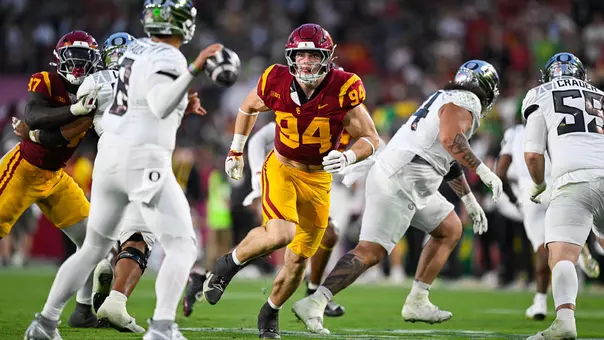
That mindset helped Bryant settle into USC’s defense. Even after earning a starting role, he did not try to immediately become the loudest voice in the room. Before telling his teammates how things should be done, he wanted to show them what he could do.
“I’m a guy who likes to lead through his actions,” Bryant said. “I wanted to show the guys, ‘This is how you do it. This is the right way,’ and lead by example.”
That sentiment explains Bryant better than any statistic. He is not the player looking for attention after every snap, nor is he interested in delivering a speech every time something goes right. His version of leadership is simple: know the assignment, make the play, prepare for the next snap and bring everyone else with him.
There is a seriousness to the way Bryant talks about football. Even when discussing the upcoming matchup with Washington, the game carrying the most personal significance on USC’s schedule. He refuses to make it bigger than it needs to be.
He knows what the game means. He will see former teammates, coaches who helped him develop and members of the strength staff who worked with him during the early years of his college career.
“I feel like I have something to prove in that game,” Bryant said. “But every game I get an opportunity to play in is a statement game for me.”
Then, almost immediately, he brought the conversation back to his routine.
“Same approach,” he said. “The same preparation. I don’t really want to change anything.”
It is a fitting mentality for a player whose path to USC was anything but direct. Now, he gets to play in the Coliseum in front of the family whose sacrifices helped him reach this point.
When Bryant was in middle school, his mother drove him from Carson to the Inland Empire three times a week so he could compete for a top youth football program. His parents took him to camps and training sessions, traveled around the country during his recruitment and supported him throughout both his football and academic careers.
Their sacrifices remain central to his motivation.
“Just knowing how much they sacrificed for me to get here, I want to repay them by giving everything I have on the field,” Bryant said.
Bryant’s plans extend beyond the field. He is majoring in visual anthropology and hopes to become a coach after his playing career. He believes understanding different cultures and people’s backgrounds will help him form stronger connections with the players he may one day lead.
For now, however, his objective is much simpler: keep working, keep learning and continue proving himself.
USC’s Homecoming game may reconnect Bryant with the place where his college career began, but his focus remains firmly on the program he represents now.
“I just want to go out there and attack it like I do every game,” Bryant said.
For Bryant, that is the point. No matter the opponent or the history attached to the matchup, his approach remains the same: put his head down, trust his preparation and get to work.