By Jai Ahuja, USC Football Communications Student Assistant
10/30/2026
One afternoon during his eighth-grade football season, Carson Tabaracci’s coach, Shawn Long, pulled him aside during practice and made a request.
“When you make it to the big leagues, you have to give me a ticket.”
At the time, Tabaracci was a young quarterback in Park City, Utah, still years away from college football. Long's comment came just one or two games into the season, an unexpected expression of confidence that Tabaracci did not fully understand until much later. Shortly afterward, Coach Long unexpectedly passed away in a car accident.
Nearly a decade later, Tabaracci still thinks about that conversation. He remembers Long as a great leader who always gave back to his community, but his coach's legacy extends beyond any one memory. The loss brought a group of eighth-grade teammates closer together, forging friendships that have endured through high school and college.
“A lot of those guys are still my best friends to this day,” Tabaracci said. “We played high school together, and then a lot of us went on to play college football. I think it started with what we went through that season.”
Five players from that team eventually went on to play Division I football, an unusual accomplishment for a high school in a ski town.
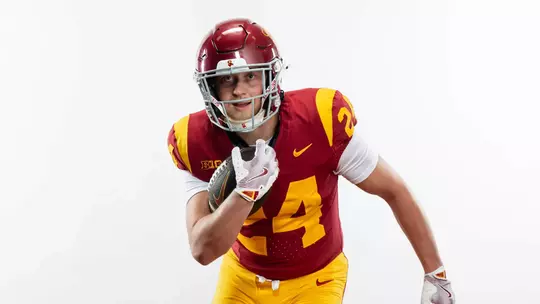
For Tabaracci, football has always been about more than the game. It is about the people who make it meaningful, the relationships that outlast a season and the responsibility to honor those who helped him along the way. That sense of purpose has followed him to USC, where the versatile tight end has built a career out of adapting to whatever his team needs.
Growing up in Utah, Tabaracci rarely spent time away from athletics. His father encouraged him and his siblings to play multiple sports, and football was part of a year-round rotation that included basketball, lacrosse and track. In high school, he played quarterback, running back, receiver and linebacker, moving around the field wherever he could help.
“My offers were all over the place,” he recalls. “Some were at linebacker, some at tight end, some at running back. I was just trying to help my high school team as much as I could.”
That willingness to embrace different roles carried him through an unconventional path to Southern California. After enrolling early at Utah, he spent a semester there before transferring to USC as an inside linebacker. He stayed on defense for a year and a half before switching to tight end, a position that let him draw on his offensive experience and his understanding of defensive schemes.
“When you learn about schemes and how everything works, and you're fully immersed in that situation, it definitely helps you when you get to the other side of the ball,” Tabaracci says.
At tight end, Tabaracci has had to learn the nuances of a position that demands both physicality and finesse. He might block alongside the offensive line on one play and create separation as a receiver on the next. He admires players such as Kyle Juszczyk and Taysom Hill, whose versatility has allowed them to contribute in different ways. Jumping around the field has helped Tabaracci develop a unique perspective on playing his position, despite being smaller than the average tight end.
“I'm not six-foot-five,” he said. “It's about knowing my role and using my advantages, usually being a little bit quicker and maybe a little better in space at times. You've got to use those things to your advantage.”
His ability to adapt has been tested by more than position changes. Injuries, including back surgery early in his time at USC and a broken neck, have forced him to watch from the sideline when he wanted nothing more than to play. During these periods of injury, he initially struggled with the fact that he couldn’t help his team on the field.
“We work all year for this. We put so much time and effort into college football, trying to be the greatest we can be on Saturdays,” he said. “Being hurt is hard, no matter what. But as I've gotten older, I've realized I can help the team in other ways, too. If you're hurt, don't beat yourself up over not being on the field. Find other ways to make an impact.”
That lesson has shaped his approach to leadership. When injuries sidelined him, he found ways to support his teammates during pregame warmups and throughout the season. Now a veteran in the program, he tries to offer younger players the same guidance and support he once needed himself.
“I’ve been through a lot of the things that they’re facing right now, and I just try to help in any way I can,” he reflects
His instinct to look after others is something Tabaracci traces back to his family, particularly his father, who played 12 years in the NHL as a goaltender. As important as sports were, academics were always a focus in the Tabaracci household.
One lesson came when Tabaracci was young. His father noticed he was struggling with reading and made the difficult decision to pull him out of hockey, a sport he loved, so that he could focus on school. Each morning, his father took him to school early to attend a reading program before the regular school day began. It was a formative experience for a child whose life revolved around sports. His father was willing to sacrifice something that both he and his son loved because he understood that his son's future depended on more than what happened on the ice.
“My dad was really big on hard work growing up,” Tabaracci said. “He'd take us to work with him, and I think he did a great job of trying to mold us. He was always making hard decisions, doing the right thing and taking care of our family. He's a man of his word; a guy you can rely on.”
Tabaracci hopes to carry those same qualities into his own life. He wants to be someone others can rely on, whether that means offering advice, helping a younger player adjust to college or simply being there when things get difficult. As the oldest of four siblings, he similarly sees himself as an example for his younger brothers, one of whom plays at San José State. His other brother plays at Saddleback College, and his youngest sister is considering college volleyball.
“I want to set the right example for them and show them the way,” Tabaracci says. “My parents have sacrificed a lot to put me in the right positions, and they've taught me a lot about our family name and who we are. I just try to honor that last name every single day.”
Long's influence fits naturally alongside those motivations. The friendships that began during that eighth-grade season remain among the most meaningful in Tabaracci's life. The fact that so many of those players continued to college football is a source of pride, but the bond itself matters just as much.
Long's words have stayed with Tabaracci because they represent something larger than a prediction about his football career. They remind him of someone who believed in him, of a group of friends who grew closer through loss, and of the people who helped shape the player and person he has become.
At USC, Tabaracci continues to work toward the future his coach imagined for him. His path has included position changes, injuries and difficult stretches away from the field, but he has learned that success is not measured solely by what he accomplishes individually. It is also measured by how he treats people, how he responds when circumstances change and what he carries forward from those who came before him.