Jai Ahuja, USC Football Communications Student Assistant
11/20/2026
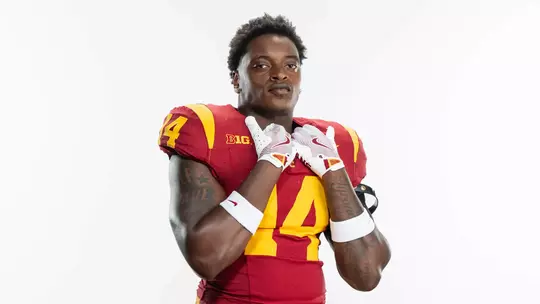
For Ta’Mere Robinson, the path to USC began in the stands rather than on the field. Growing up in Pittsburgh, Robinson spent much of his childhood watching his older brother, Bruce, play high school football. Being thirteen years older than him, Bruce was a role model in all facets of Robinson’s life.
“My dad wasn’t in my life, so growing up, he was the only male that I had to really put my focus on. I always looked up to my older brother,” recalls Robinson.
While in high school, Robinson’s brother would take him outside to work on drills. That relationship continued even when his brother left for college, checking in on him from a distance, making sure he stayed committed to football. After games, Robinson would call to share his highlights, and Bruce was always there to encourage him.
“How’s football going?” he’d say. “You doing this? You doing that? Just because I’m gone doesn’t mean you stop doing the things you’re supposed to.”
Now, Robinson finds himself on the other side of that relationship. His brother has three children, two sons and a daughter, who have grown up watching their uncle play. His nephews have become involved in sports themselves, playing flag football and calling Robinson to tell him about their games. When he returns home, he makes a point of visiting his brother’s house to throw the football around in the backyard.
“They’ll call me from back home and be like, ‘I had a flag football game today, and I did this, I did that,’” Robinson said. “It amazes me because I’m looking at them like they were my younger self.”
His niece has developed her own way of keeping up with him. Whenever they talk, she wants to know when his next game is and when she will get to watch him play. For Robinson, those conversations are a reminder of the impact he can have simply by being someone his family can look up to.
“Just being able to put a smile on their face and keep them happy is what truly keeps me going,” said Robinson.
That sense of responsibility has followed Robinson throughout a college career that has required plenty of patience and resilience. His path to USC was not a straight shot. After emerging as a highly regarded recruit, he faced an injury that threatened to derail his momentum before he had the chance to finish his high school career. Robinson suffered the injury just before the playoffs of his junior season, ultimately missing his entire senior season as well.
“I remember, right after I got hurt, my first thought was, ‘It’s probably over for me,’” Robinson said. “I never had any injuries leading up to that point, and I never had to get surgery either. So I was like, all right, what’s this bounce back going to be like?”
With college coaches already showing interest, the uncertainty was difficult to process. Penn State, however, continued to stand by him. The coaching staff even put together a video in which they wore No. 3 jerseys, his high school number, and sent messages wishing him a full recovery. That commitment helped make Penn State an easy choice. Staying close to Pittsburgh and joining a program he had grown up knowing made the opportunity especially meaningful.
The transition to college football brought another challenge. Robinson had played safety in high school, but at Penn State he moved to linebacker. After missing a year of football, he was suddenly tasked with rebuilding his confidence while learning an entirely new position and playbook.
“It was hard at first,” Robinson said. “Coming from high school, being a four-star recruit, and then not playing your senior year, missing a whole year of football, and then going to college. And I played safety in high school, so then I go to college, and I had to play a whole new position.”
The adjustment required more than simply learning a new spot on the field. He had to earn the trust of a new coaching staff, build relationships with teammates and find his place in a locker room full of highly recruited players. Consistency and a willingness to buy into the process eventually helped him settle in.
After redshirting his freshman year, Robinson appeared in all 14 games during his second season at Penn State, gaining valuable experience in one of college football’s most demanding environments. But even with that success, he eventually felt it was time for a change. He entered the transfer portal looking for a place where he could reset, both personally and athletically.
A visit to USC helped make the decision easy. After meeting legendary NFL coach Rob Ryan, who would coach him as a linebacker, and the rest of the Trojan staff, Robinson saw an opportunity to start a new chapter on the other side of the country.
“I came out here and saw USC and LA and just thought, man, this is the place to be,” said Robinson.
The move from Pennsylvania to Los Angeles was a significant one, especially for someone who had always been close to his family. But the transition became easier as he began building relationships within the team. On his first day in Los Angeles, his new teammates, linebackers Desman Stephens II and Eric Gentry, took him to breakfast and made sure he felt welcome.
“Welcome, man. It’s a brotherhood here,” they said. “We got you. If you need anything, just let us know.”
That sense of belonging mattered. Robinson had to establish himself in another new defensive system while continuing to work through injuries that had lingered since his time in high school.
This season, he says, his body feels better than it has at any point since that original injury. Just as importantly, he has found a greater sense of comfort in his role within the team.
“Last year, I felt like I didn’t have that leadership role,” Robinson explained. “I felt like I couldn’t use it because I didn’t have a voice on the team yet. But this year, I feel like I can be vocal. I feel like I can truly be a leader.”
For a player who has spent much of his life learning from the people around him, becoming a leader was another important step. The experience of moving between programs, adjusting to new positions and working through setbacks has given him a perspective he can now share with younger teammates.
It is a responsibility he hopes to carry beyond football, too. Robinson's interest in working with young people began with one of his own childhood mentors. His kindergarten teacher, Miss O’Neill, made such a lasting impression that she still reaches out to him and his family years later. In high school, he joined a teaching magnet program, where he learned about education, studied challenges within the school system and spent time working with elementary and middle school students. In the future, he hopes to become a guidance counselor, where he can make an impact across an entire school.
“I think I would work with middle school students because I feel like that’s where a lot of kids start to find themselves or have trouble finding themselves,” Robinson said.
“Actually, that was me,” he reflected. “I didn’t have a father in my life, so I would definitely want to be that male figure in a kid’s life.”
He sees counseling as a way to reach more students than he might through a single classroom, allowing him to connect with anyone who needs someone to talk to. He has already taken small steps toward that goal, including visiting a youth football practice in Pittsburgh, where he spoke with players and helped the linebackers work through drills.
The connection between his own childhood and the person he hopes to become is clear. His brother helped give him direction when he was young. Now, his nephews and niece watch him with that same admiration, and he hopes to offer other children the kind of support that made such a difference in his own life.
For Robinson, the goal is not simply to become someone worth watching on Saturdays. His brother once gave him someone to look up to. Now, Robinson hopes to become that person for the next generation, both within his family and beyond it.