University Southern California Trojans
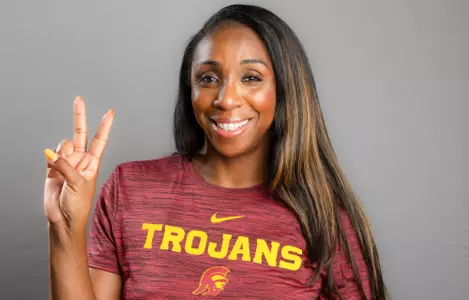
Q&A with Sprints and Hurdles Coach Lashinda Demus
July 15, 2026 | Track & Field
Olympic gold medalist Lashinda Demus enters her second season with USC Track and Field, taking on a greater role as an assistant coach for sprints and hurdles.
"We're excited to bring Coach Demus onto our staff in a larger capacity for her second season," said Quincy Watts, Director of USC Track & Field and Cross Country. "She adds to our championship culture from her own collegiate and Olympic career, and she encourages our athletes to reach their strongest potential. We're looking forward to having her energy and experience with the program."
Demus was a two-time SEC Champion and four-time NCAA champion for the University of South Carolina Gamecocks. She won NCAA titles in the indoor 400 meters in 2003, indoor 4×400-meter relay in 2002, outdoor 400-meter hurdles in 2002, and the outdoor 4×400-meter relay in 2002. She also contributed to their national team title in 2002.
Demus went on to become a five-time World Championship medalist in 400m hurdles and 4x400m relay, and won the 400m hurdles at the 2012 London Olympic Games.
How were you first introduced to USC and what were your perceptions of USC before you came into your first year?
I'm from LA, and I actually learned how to ride my bicycle in the Coliseum parking lot with my dad. It was a hometown school. My dad actually wanted me to come to college here and I ended up going to the other USC. But it's always been a track dominant school.
I've always known it to be exactly what it has been. I was familiar with the former coaches of Ron Allice and Coach Edmondson. I've known them, actually spoken with them and still remain pretty close with them. It's always been a part of the culture of LA for me. It's just full circle now that I'm here.
What was your initial transition from being a pro to a coach like?
So I officially stopped running professionally in 2017. Even while I was professionally training, I was still volunteer coaching. I was at the junior college level and the high school level. When I stopped training or competing professionally, I just focused on the high school level.
I wanted to give what I've received from the sport and give other kids opportunities to run collegiately. That was my goal and what I set out to do. I ended up having kids that are successful, kids that were recruited and top in the country. I began to get noticed by college coaches as a coach instead of a professional athlete like I was. That's kind of been the road leading up to now. Since I am here in LA, it was the perfect opportunity for me.
What are your reflections and takeaways from your first year here?
I think it was different. I came from coaching high school kids where I was a very stern coach and had to actually push more for kids to do what I wanted them to do training wise, but the college level is different. You don't have to persuade athletes as much to do what they need to do to be good. I think that it was just getting acclimated to the college season, the training and the scheduling.
It wasn't a major difference and it wasn't anything that I didn't expect because I have been in the college world and the professional world. It was just getting to know the team, getting to know the coaches and knowing the lay of the land.
Is there anything that surprised you or you learned about the Division I level?
What I learned coming here is that more female presence is needed in the sport, more female leadership and track and field is needed, and I'm filling a gap. A needed one. So I knew that my voice would be used. I know that it would be heard. And I know that I would benefit men and women on this college team.
Have you been able to bring that into conversation with your female athletes and provide lessons as a woman in the sport?
I think it's more of integrating it in the lifestyle of how you coach and how you train. So I think that I kind of present a mindset that I'm teaching that I think that they should have in order to be the best. One thing I know how to do and have a doctorate degree in is being a beast, being a dog, having a mindset of a champion and being the best. So I think it's more than just saying it. You kind of have to ingrain it in people's mind and you kind of have to exude it with your presence. And that's what I give.
Can you give us some insight into your coaching philosophy?
I want to bring back that mental toughness that athletes are willing to run through a wall to get whatever they want. And when I start seeing more of that, I will be happy.
I also think being able to multitask, and that being said, having a plan on the athletic side, having a plan on your academic side, you can do both at once. You don't have to focus on one thing for one time. Like you can do both and you should do both.
This is a prestigious school and you should definitely take advantage of your surroundings, your professors, all of the above. So I want to instill that as well.
Why is USC the pLAce to be?
USC is the pLAce to be because it is the training grounds for the next Olympians. If you want to pursue sports at a high level and you want to stand on top of that podium, I think this is the landing strip. It just has that environment. It has the culture already connected to it. Kids come here and expect to be great just because they've seen the greats that came here. So this is the place to be if you want to be the best, the Olympian, the world champion, the gold medalist, you name it.
"We're excited to bring Coach Demus onto our staff in a larger capacity for her second season," said Quincy Watts, Director of USC Track & Field and Cross Country. "She adds to our championship culture from her own collegiate and Olympic career, and she encourages our athletes to reach their strongest potential. We're looking forward to having her energy and experience with the program."
Demus was a two-time SEC Champion and four-time NCAA champion for the University of South Carolina Gamecocks. She won NCAA titles in the indoor 400 meters in 2003, indoor 4×400-meter relay in 2002, outdoor 400-meter hurdles in 2002, and the outdoor 4×400-meter relay in 2002. She also contributed to their national team title in 2002.
Demus went on to become a five-time World Championship medalist in 400m hurdles and 4x400m relay, and won the 400m hurdles at the 2012 London Olympic Games.
How were you first introduced to USC and what were your perceptions of USC before you came into your first year?
I'm from LA, and I actually learned how to ride my bicycle in the Coliseum parking lot with my dad. It was a hometown school. My dad actually wanted me to come to college here and I ended up going to the other USC. But it's always been a track dominant school.
I've always known it to be exactly what it has been. I was familiar with the former coaches of Ron Allice and Coach Edmondson. I've known them, actually spoken with them and still remain pretty close with them. It's always been a part of the culture of LA for me. It's just full circle now that I'm here.
What was your initial transition from being a pro to a coach like?
So I officially stopped running professionally in 2017. Even while I was professionally training, I was still volunteer coaching. I was at the junior college level and the high school level. When I stopped training or competing professionally, I just focused on the high school level.
I wanted to give what I've received from the sport and give other kids opportunities to run collegiately. That was my goal and what I set out to do. I ended up having kids that are successful, kids that were recruited and top in the country. I began to get noticed by college coaches as a coach instead of a professional athlete like I was. That's kind of been the road leading up to now. Since I am here in LA, it was the perfect opportunity for me.
What are your reflections and takeaways from your first year here?
I think it was different. I came from coaching high school kids where I was a very stern coach and had to actually push more for kids to do what I wanted them to do training wise, but the college level is different. You don't have to persuade athletes as much to do what they need to do to be good. I think that it was just getting acclimated to the college season, the training and the scheduling.
It wasn't a major difference and it wasn't anything that I didn't expect because I have been in the college world and the professional world. It was just getting to know the team, getting to know the coaches and knowing the lay of the land.
Is there anything that surprised you or you learned about the Division I level?
What I learned coming here is that more female presence is needed in the sport, more female leadership and track and field is needed, and I'm filling a gap. A needed one. So I knew that my voice would be used. I know that it would be heard. And I know that I would benefit men and women on this college team.
Have you been able to bring that into conversation with your female athletes and provide lessons as a woman in the sport?
I think it's more of integrating it in the lifestyle of how you coach and how you train. So I think that I kind of present a mindset that I'm teaching that I think that they should have in order to be the best. One thing I know how to do and have a doctorate degree in is being a beast, being a dog, having a mindset of a champion and being the best. So I think it's more than just saying it. You kind of have to ingrain it in people's mind and you kind of have to exude it with your presence. And that's what I give.
Can you give us some insight into your coaching philosophy?
I want to bring back that mental toughness that athletes are willing to run through a wall to get whatever they want. And when I start seeing more of that, I will be happy.
I also think being able to multitask, and that being said, having a plan on the athletic side, having a plan on your academic side, you can do both at once. You don't have to focus on one thing for one time. Like you can do both and you should do both.
This is a prestigious school and you should definitely take advantage of your surroundings, your professors, all of the above. So I want to instill that as well.
Why is USC the pLAce to be?
USC is the pLAce to be because it is the training grounds for the next Olympians. If you want to pursue sports at a high level and you want to stand on top of that podium, I think this is the landing strip. It just has that environment. It has the culture already connected to it. Kids come here and expect to be great just because they've seen the greats that came here. So this is the place to be if you want to be the best, the Olympian, the world champion, the gold medalist, you name it.
Wednesday, June 17
Sunday, May 17
Thursday, May 14
Saturday, March 28