University Southern California Trojans
Players Mentioned
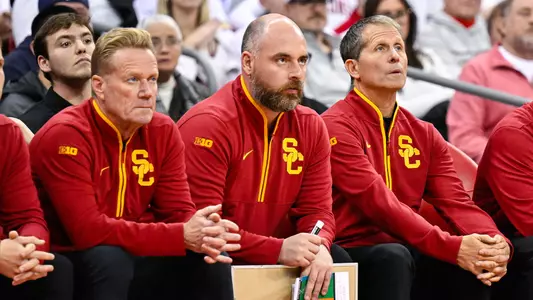
Photo by: John McGillen
Q&A with Assistant Coach Anthony Ruta
June 19, 2026 | Men's Basketball
LOS ANGELES — With a talented mix of returners, transfers and blue-chip freshman recruits, the USC Men's Basketball team is looking to make the NCAA Tournament in Head Coach Eric Musselman's third year. Assistant Coach Anthony Ruta, who is entering his third season with USC, took time to share about his relationship with Head Coach Eric Musselman, his coaching journey and expectations for the team and schedule during the upcoming season.
You've known Coach Musselman the longest out of everyone on the coaching staff, aside from his son Michael. What has working with him been like for you and how have you seen your working relationship with him develop over the years?
My relationship with Coach Musselman started when I was a grad assistant at Arizona State. He was transitioning from the professional world to college. The first thing that stood out was how Coach Musselman treated everyone, including staff members, managers, grad assistants, and support staff. We built a strong bond and worked together for two years. Besides my dad, Coach Musselman has had a significant impact on my life, as a role model.
The two years at Arizona State were a crash course in basketball, covering offense, defense, and recruiting. I carry the lessons he taught me to this day. After a year apart, we reunited at Nevada for four years, then at Arkansas for five years, and now we're in our third year at USC. It's been amazing to see the consistency in Coach Musselman's character and how he interacts with everyone. It's something I strive to emulate daily.
How did you get into coaching basketball?
I went to Arizona State initially as a student and I'd always wanted to get into coaching. I didn't know even what sport or at what level, but basketball was always my first love, sport-wise. I worked my way from the bottom up. I've been really fortunate with my combination of hard work, and the relationships I've formed. I had a lot of luck to be able to get my foot in the door and then once I got my foot in the door, being able to keep it rolling has been a really interesting journey.
When I first started off I didn't have any connections, or family members or friends in the business. I had to blaze my own path. Once you get your foot in the door and people see that you're hardworking and that no job is too big or too small for you, you can cave out a niche and see where it goes.
What sports did you play in high school?
In high school I played basketball and football. My main sport was football. Going into my senior year, I thought I would go to a Division 2 or Division 3 school and play football in the Northeast. I reached a point towards the end where I wanted to have a true college experience, so I pivoted on a whim and went out to Arizona State. I'd never even been out to the West Coast before or anything. I knew if I didn't like it, I could always come back to what I know, so I might as well just try it out.
What are some of the things that you would tell an up-and-coming assistant or grad assistant or a student manager who wants to get into coaching? What would you tell them to focus on to break through?
The biggest thing is just that no job is too big or too small. It's easy to do the jobs everybody wants to do, but jump in and do the jobs that people don't want to do. Then, just try to carve out one or two niches where the program cannot survive without you because you're so good in these two areas. Now, obviously you want to be as well rounded as possible, but just try to carve out a niche so that you're irreplaceable. Then when someone else on staff gets a head job or has a friend that gets a head job, you can get recommended. The best way to be able to advance and stay in this business is to be hardworking and find a niche.
Speaking about the specific jobs you do, you play a big role in scheduling for the staff. How have you noticed scheduling philosophy change with analytics — especially with the NET rankings?
It's definitely changed with analytics, but the transfer portal has definitely changed things too. Every single year, everybody's rosters are flipping constantly. Being able to stay ahead of the curve and know which players are transferring in and out from an analytical standpoint, or figuring out how teams traditionally do under a head coach is key.
In the last 5-10 years, we've really shifted from the traditional home-and-home series to these one-game neutral site games, or even a home-and-home series on neutral sites — like if a team comes to LA and plays us on a neutral site, then we might return the game somewhere on the East Coast. And another big piece of it is now that Power-4 teams play 20 conference games, you need two less non-conference games and you're playing two more harder games in conference. In the Big Ten, 17 or 18 of your games are going be Quad 1 or Quad 2 games, so you have to toe the line between making sure you schedule enough, and not overscheduling. And with the NCAA tournament expanding, I think we're all trying to figure out what that means for the metrics.
How do you feel about the NCAA tournament expansion?
I'm for it. A lot of people are traditionalists and want to see the tournament stay at 68 teams after they expanded from 64 teams. It's an ever-evolving thing. Also, it might be a handful of teams every single year, but more teams are transitioning to Division 1, so we don't have the same amount teams that we had 10 years ago. That number's multiplying, which is good for the game, but also it's brings more opportunities to get into the NCAA Tournament.
Without giving too much away, how do you feel about the non-conference schedule and how do you think it will prepare you guys for the Big Ten?
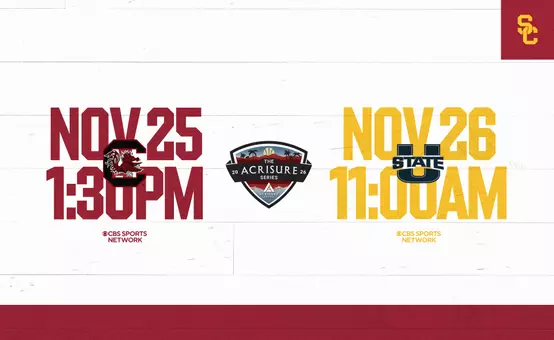
We're really excited about the way the non-conference schedule is shaping up. We're really going to challenge our guys. Last year, we felt like the Maui Invitational was a great test. The NCAA added an additional non-conference game this year, so we're going to really challenge ourselves and try to play more games away to manipulate the analytics a little bit. We're excited with where we're at right now.
Speaking of this year, USC has a brand new roster with 10 newcomers. What have you seen from them so far in practice and what makes you excited about this year?
The thing that makes us most excited about this group right now is every single day, we're going back to our offices and talking about a different guy standing out after every practice. It's not the same guy standing out every single day — we've had teams in the past where it's the same one or two guys. What we're most excited about is, you know, to a man, every single guy has had a practice early on that we're like, "wow, he's a really good player." We're excited about our depth. We feel like we have a really good balance with three returners back, three freshmen that are McDonald's All-Americans and a really good transfer portal class.
How have you seen returners Alijah Arenas, Rodney Rice and Jacob Cofie grow and step into bigger leadership roles so far?
Jacob has been way more vocal. He had a great experience being able to test the waters in the NBA, and advance from the G-League to the NBA Combine. Michael Musselman and I went out to see him while he was at the NBA Combine in Chicago, and you could just tell he was oozing with confidence.
With Rodney being here for a second year now and knowing the terminology will help a lot. This time last year we were trying to transition Rodney to a point guard. Now he's two feet in with the position. He's super confident and knows what his expectations are as a point guard, both with running the offense and then with what we're doing defensively.
With Alijah, he was thrown into the deep end last year in the middle of Big Ten play. But he continues to grow and he's stacking good days on top of each other, so we're really excited for Alijah as well.
You also put together a talented portal class, including two sought-after transfers in Eric Reibe and KJ Lewis, plus several productive mid-major players. How do you think they're integrating with the rest of the roster so far?
One thing that we really tried to attack in the transfer portal was maturity and leadership. We've done a really good job not only bringing in leaders with maturity and experience, but also guys guys with specific skill sets. We have multiple traditional point guards in Aaron Hunkin-Claytor and Jalen Cox, a back-to-the-basket big in Eric Reibe that can also step out and make threes. We have somebody like KJ Lewis — who we've actually recruited three different times. Isaac Bruns will be a knockdown shooter. Jadis Jones is going to be a junkyard dog. Taking every single one of those guys with a couple important character traits that really stand and being able to blend it all together as a team will be important.
How have you seen the three freshman McDonald's All-Americans — Christian Collins, plus Adonis and Darius Ratliff — adjust to college basketball after having such prolific high school careers?
All three of them have done a really good job of being super coachable and open-minded to everything — whether that's on the basketball floor, in the training room, in the strength and conditioning room, or being with our dietitian. They're taking everything in and we're throwing a lot at them right now. Those guys have done a really good job of learning and being open-minded. Obviously, all three of them are super talented being McDonald's All-Americans, but being open-minded to coaching is the biggest thing that stands out amongst the three of them.
What should fans expect to see from USC men's basketball this year?
From a team perspective, our fans are going to see a group that is diving on the floor for loose balls and playing with great energy. I think the fans are going to see this infectious energy in the Galen Center. When fans come to a game, they're going to say "wow, that USC team plays hard."
You've known Coach Musselman the longest out of everyone on the coaching staff, aside from his son Michael. What has working with him been like for you and how have you seen your working relationship with him develop over the years?
My relationship with Coach Musselman started when I was a grad assistant at Arizona State. He was transitioning from the professional world to college. The first thing that stood out was how Coach Musselman treated everyone, including staff members, managers, grad assistants, and support staff. We built a strong bond and worked together for two years. Besides my dad, Coach Musselman has had a significant impact on my life, as a role model.
The two years at Arizona State were a crash course in basketball, covering offense, defense, and recruiting. I carry the lessons he taught me to this day. After a year apart, we reunited at Nevada for four years, then at Arkansas for five years, and now we're in our third year at USC. It's been amazing to see the consistency in Coach Musselman's character and how he interacts with everyone. It's something I strive to emulate daily.
How did you get into coaching basketball?
I went to Arizona State initially as a student and I'd always wanted to get into coaching. I didn't know even what sport or at what level, but basketball was always my first love, sport-wise. I worked my way from the bottom up. I've been really fortunate with my combination of hard work, and the relationships I've formed. I had a lot of luck to be able to get my foot in the door and then once I got my foot in the door, being able to keep it rolling has been a really interesting journey.
When I first started off I didn't have any connections, or family members or friends in the business. I had to blaze my own path. Once you get your foot in the door and people see that you're hardworking and that no job is too big or too small for you, you can cave out a niche and see where it goes.
What sports did you play in high school?
In high school I played basketball and football. My main sport was football. Going into my senior year, I thought I would go to a Division 2 or Division 3 school and play football in the Northeast. I reached a point towards the end where I wanted to have a true college experience, so I pivoted on a whim and went out to Arizona State. I'd never even been out to the West Coast before or anything. I knew if I didn't like it, I could always come back to what I know, so I might as well just try it out.
What are some of the things that you would tell an up-and-coming assistant or grad assistant or a student manager who wants to get into coaching? What would you tell them to focus on to break through?
The biggest thing is just that no job is too big or too small. It's easy to do the jobs everybody wants to do, but jump in and do the jobs that people don't want to do. Then, just try to carve out one or two niches where the program cannot survive without you because you're so good in these two areas. Now, obviously you want to be as well rounded as possible, but just try to carve out a niche so that you're irreplaceable. Then when someone else on staff gets a head job or has a friend that gets a head job, you can get recommended. The best way to be able to advance and stay in this business is to be hardworking and find a niche.
Speaking about the specific jobs you do, you play a big role in scheduling for the staff. How have you noticed scheduling philosophy change with analytics — especially with the NET rankings?
It's definitely changed with analytics, but the transfer portal has definitely changed things too. Every single year, everybody's rosters are flipping constantly. Being able to stay ahead of the curve and know which players are transferring in and out from an analytical standpoint, or figuring out how teams traditionally do under a head coach is key.
In the last 5-10 years, we've really shifted from the traditional home-and-home series to these one-game neutral site games, or even a home-and-home series on neutral sites — like if a team comes to LA and plays us on a neutral site, then we might return the game somewhere on the East Coast. And another big piece of it is now that Power-4 teams play 20 conference games, you need two less non-conference games and you're playing two more harder games in conference. In the Big Ten, 17 or 18 of your games are going be Quad 1 or Quad 2 games, so you have to toe the line between making sure you schedule enough, and not overscheduling. And with the NCAA tournament expanding, I think we're all trying to figure out what that means for the metrics.
How do you feel about the NCAA tournament expansion?
I'm for it. A lot of people are traditionalists and want to see the tournament stay at 68 teams after they expanded from 64 teams. It's an ever-evolving thing. Also, it might be a handful of teams every single year, but more teams are transitioning to Division 1, so we don't have the same amount teams that we had 10 years ago. That number's multiplying, which is good for the game, but also it's brings more opportunities to get into the NCAA Tournament.
Without giving too much away, how do you feel about the non-conference schedule and how do you think it will prepare you guys for the Big Ten?
We're really excited about the way the non-conference schedule is shaping up. We're really going to challenge our guys. Last year, we felt like the Maui Invitational was a great test. The NCAA added an additional non-conference game this year, so we're going to really challenge ourselves and try to play more games away to manipulate the analytics a little bit. We're excited with where we're at right now.
Speaking of this year, USC has a brand new roster with 10 newcomers. What have you seen from them so far in practice and what makes you excited about this year?
The thing that makes us most excited about this group right now is every single day, we're going back to our offices and talking about a different guy standing out after every practice. It's not the same guy standing out every single day — we've had teams in the past where it's the same one or two guys. What we're most excited about is, you know, to a man, every single guy has had a practice early on that we're like, "wow, he's a really good player." We're excited about our depth. We feel like we have a really good balance with three returners back, three freshmen that are McDonald's All-Americans and a really good transfer portal class.
How have you seen returners Alijah Arenas, Rodney Rice and Jacob Cofie grow and step into bigger leadership roles so far?
Jacob has been way more vocal. He had a great experience being able to test the waters in the NBA, and advance from the G-League to the NBA Combine. Michael Musselman and I went out to see him while he was at the NBA Combine in Chicago, and you could just tell he was oozing with confidence.
With Rodney being here for a second year now and knowing the terminology will help a lot. This time last year we were trying to transition Rodney to a point guard. Now he's two feet in with the position. He's super confident and knows what his expectations are as a point guard, both with running the offense and then with what we're doing defensively.
With Alijah, he was thrown into the deep end last year in the middle of Big Ten play. But he continues to grow and he's stacking good days on top of each other, so we're really excited for Alijah as well.
You also put together a talented portal class, including two sought-after transfers in Eric Reibe and KJ Lewis, plus several productive mid-major players. How do you think they're integrating with the rest of the roster so far?
One thing that we really tried to attack in the transfer portal was maturity and leadership. We've done a really good job not only bringing in leaders with maturity and experience, but also guys guys with specific skill sets. We have multiple traditional point guards in Aaron Hunkin-Claytor and Jalen Cox, a back-to-the-basket big in Eric Reibe that can also step out and make threes. We have somebody like KJ Lewis — who we've actually recruited three different times. Isaac Bruns will be a knockdown shooter. Jadis Jones is going to be a junkyard dog. Taking every single one of those guys with a couple important character traits that really stand and being able to blend it all together as a team will be important.
How have you seen the three freshman McDonald's All-Americans — Christian Collins, plus Adonis and Darius Ratliff — adjust to college basketball after having such prolific high school careers?
All three of them have done a really good job of being super coachable and open-minded to everything — whether that's on the basketball floor, in the training room, in the strength and conditioning room, or being with our dietitian. They're taking everything in and we're throwing a lot at them right now. Those guys have done a really good job of learning and being open-minded. Obviously, all three of them are super talented being McDonald's All-Americans, but being open-minded to coaching is the biggest thing that stands out amongst the three of them.
What should fans expect to see from USC men's basketball this year?
From a team perspective, our fans are going to see a group that is diving on the floor for loose balls and playing with great energy. I think the fans are going to see this infectious energy in the Galen Center. When fans come to a game, they're going to say "wow, that USC team plays hard."
Monday, June 22
Monday, June 22
Monday, June 22
Monday, June 22