University Southern California Trojans
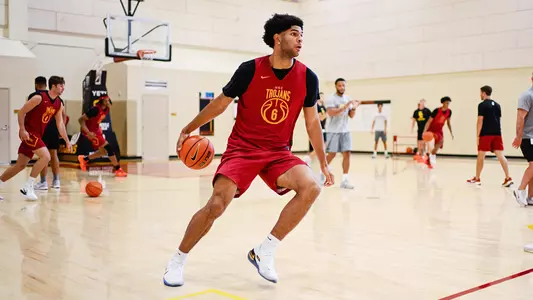
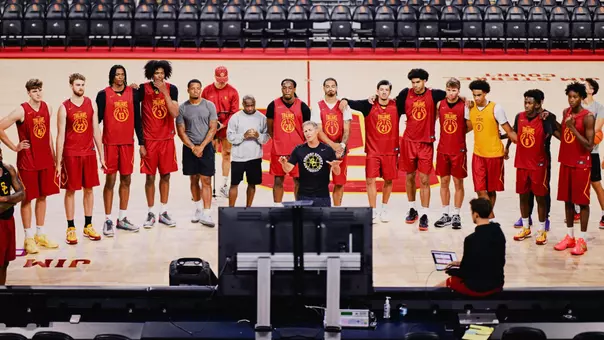
Photo by: John McGillen
Q&A with Jacob Cofie
August 06, 2026 | Men's Basketball
LOS ANGELES — With a talented mix of returners, transfers and blue-chip freshman recruits, the USC Men's Basketball team is looking to make the NCAA Tournament in Head Coach Eric Musselman's third year.
Junior forward Jacob Cofie sat down to talk about his experience at the NBA and G-League Combines, his expectations for the season and finding his voice as a leader on the team.
The NBA and G-League Combines were huge opportunities for you to prove yourself. What was that process like from starting at the G League Combine and moving up, and what did you learn from it?
I learned to keep my head down. I was a little discouraged going into the G-League Combine because I felt like I was not a G-League player at all. But my agent told me that I should use it as motivation to work my way up and get the call-up to the NBA Combine. That's what I ended up doing.
I had a chip on my shoulder at the G-League combine, went to the NBA combine and kept that same confidence and believed in myself and my capabilities. I proved that I belong there. It was a good experience for me, seeing those great players and seeing that I feel like I'm even better than some of those players already there. Coming back to college is a cool experience where I can keep working on my game, get better, and be a higher pick next year.
I think I have a good shot next year to prove everything. I want to be one of the top players in the Big 10. I think that's huge for my development and for us to do well as a team.
What was some of the feedback you got along the way?
A lot of NBA teams want to see me shoot the 3-ball even more. They want to see a lot more attempts and at a higher percentage. They want to see me getting bigger and show my versatility on the defensive end — they want to see that same level of intensity and even up it a notch. If I do those things, I feel I'd be a first-round pick.
Last year, you were really finding your rhythm on both ends of the floor and gaining confidence throughout the year before you performed very well towards the end of the year. How did you feel towards the end of the season and what were some of the takeaways that you had from that time?
At the end of the season, I wanted to make that push for us to make the NCAA Tournament. I felt like for us to win some games, I had to play better, put better stats up for us to win games and get more baskets for us. That's where that came from. I had to pick it up a notch for us to make the tournament and I was very disappointed when we didn't make it. I think [Head Coach Eric] Musselman instilled a little bit more confidence in me and I was ready to hoop.
Getting back to the tournament and making some noise is one of the main goals for you guys this summer. What do you think it'll take to get there? What have you seen throughout the summer that's given you optimism?
What it'll take for us to get there is everyone buying into their roles. We have so many stars on our team. I think that means we have to buy into what we're all good at — let's not get into roles that we're not strong at. Once everyone figures out their role during this next segment, we'll be really good. I think with everyone being back, we'll figure that out and be a strong team.
After this eight-week block of practice and getting to know so many newcomers, what do you think the team's identity is right now? What do you think some of the strengths of the team are?
Our strengths right now would be versatility. We can run a lot of different lineups: a long, tall lineup, a fast lineup, a big lineup. I also think a lot of players on our team have the capability of shooting. I don't think we'll ever have two non-shooters on the court, which is a plus for us.
For fans that haven't seen this group, what do you think they should expect to see when they go to a USC men's basketball game?
Fans should look forward to seeing us. It'll always be a different guy's night. I think you'll never know going into the game who's going to just pop out with a lot of energy and spirit that you can't see on the stat sheets. There's not going to be just one guy. I feel we have so many guys that you'll notice throughout the year. You don't know who's going to have an extremely good game. I think that's what's so good about our team.
You're one of the three returners. In practices, the coaches rely on you a lot to set an example for the guys. What's it been like to grow into a leadership role?
Being a leader is fun. It makes you really step into that role — being on time every day pushes you to another level, because if you're not coming ready to play that day, then the team won't. If your leader's not doing the right things, then the team won't. Holding myself to that high standard to come in and work hard every day is great for me and for the team.
Muss has coached a lot of NBA players and sometimes he compares you guys to other players that he's sent to the league. Which players has he told you that you can learn from?
I think Muss has coached a lot of athletic fours in his career. I played with one during the NBA combine — Trayvon Brazile — who is a pretty athletic four-man that can do a lot of different things and play on the perimeter. Jaylin Williams, who plays with Oklahoma City, is another similar type four-man, but we're all different in our own ways. I think that's unique about me. I have a little versatility, and those guys do as well. I just think it's cool that I've seen guys that have been coached by Muss go to the NBA.
I talked with Assistant Coach Will Conroy about the Seattle basketball scene earlier in the summer, and he said that guys from Seattle and Washington are very versatile and well-rounded. How would you describe the Seattle basketball scene?
Being from Seattle, you have a chip on your shoulder. You see all the greats in front of you. With the Seattle Rotary AAU program, you see its success rate with all the guys that were the top players on the Rotary team and how well they did with their basketball career. The high school league I played in had so much competitiveness. That's where I got my competitive edge. Being from Seattle, I think it's a great city with hoop culture. They really care about the youth and bringing them up to be even better than the players before them.
What's it like having another Seattle guy on staff?
Coach Conroy just understands me more, he understands how I grew up, how I started playing basketball and the program I've been through. He just understands me personally from my background and where I grew up. It feels good to talk to someone — even if it's not about basketball — who understands how I grew up.
How did you get into playing basketball?
I grew up playing basketball. When I was in YMCA ball, my mom was my first-ever coach. I was really good at soccer, then I grew pretty tall. I kept playing basketball. When I started playing for my feeder team in Everett, Washington, the Mariner Marauders, I got really good. Then I eventually tried out for Seattle Rotary in middle school. I grew up loving basketball after that.
What position do you play in soccer?
I was a forward. I would score a lot of goals when I was younger. I was pretty solid, but I just grew really tall. I didn't love the game of soccer that much. I think club soccer is a little pricier than AAU basketball. I was doing soccer, football and basketball at one point, and my parents told me I had to drop some of those.
What position did you play in football?
In football I was a wide receiver and I defensie end. I thought I was really good at football, but once I grew tall again, basketball was clearly the one for me.
I can kind of see you playing tight end, though.
I could see a tight end as well. If was 6-foot-5, I'd be playing D1 football right now, but I just kept growing.
What personal goals do you have for this year?
I want to be a First-Team All-Big 10 player. I want to set those high goals for myself. I believe I can do that. I just have to keep working and stacking days.
Junior forward Jacob Cofie sat down to talk about his experience at the NBA and G-League Combines, his expectations for the season and finding his voice as a leader on the team.
The NBA and G-League Combines were huge opportunities for you to prove yourself. What was that process like from starting at the G League Combine and moving up, and what did you learn from it?
I learned to keep my head down. I was a little discouraged going into the G-League Combine because I felt like I was not a G-League player at all. But my agent told me that I should use it as motivation to work my way up and get the call-up to the NBA Combine. That's what I ended up doing.
I had a chip on my shoulder at the G-League combine, went to the NBA combine and kept that same confidence and believed in myself and my capabilities. I proved that I belong there. It was a good experience for me, seeing those great players and seeing that I feel like I'm even better than some of those players already there. Coming back to college is a cool experience where I can keep working on my game, get better, and be a higher pick next year.
I think I have a good shot next year to prove everything. I want to be one of the top players in the Big 10. I think that's huge for my development and for us to do well as a team.
What was some of the feedback you got along the way?
A lot of NBA teams want to see me shoot the 3-ball even more. They want to see a lot more attempts and at a higher percentage. They want to see me getting bigger and show my versatility on the defensive end — they want to see that same level of intensity and even up it a notch. If I do those things, I feel I'd be a first-round pick.
Last year, you were really finding your rhythm on both ends of the floor and gaining confidence throughout the year before you performed very well towards the end of the year. How did you feel towards the end of the season and what were some of the takeaways that you had from that time?
At the end of the season, I wanted to make that push for us to make the NCAA Tournament. I felt like for us to win some games, I had to play better, put better stats up for us to win games and get more baskets for us. That's where that came from. I had to pick it up a notch for us to make the tournament and I was very disappointed when we didn't make it. I think [Head Coach Eric] Musselman instilled a little bit more confidence in me and I was ready to hoop.
Getting back to the tournament and making some noise is one of the main goals for you guys this summer. What do you think it'll take to get there? What have you seen throughout the summer that's given you optimism?
What it'll take for us to get there is everyone buying into their roles. We have so many stars on our team. I think that means we have to buy into what we're all good at — let's not get into roles that we're not strong at. Once everyone figures out their role during this next segment, we'll be really good. I think with everyone being back, we'll figure that out and be a strong team.
After this eight-week block of practice and getting to know so many newcomers, what do you think the team's identity is right now? What do you think some of the strengths of the team are?
Our strengths right now would be versatility. We can run a lot of different lineups: a long, tall lineup, a fast lineup, a big lineup. I also think a lot of players on our team have the capability of shooting. I don't think we'll ever have two non-shooters on the court, which is a plus for us.
For fans that haven't seen this group, what do you think they should expect to see when they go to a USC men's basketball game?
Fans should look forward to seeing us. It'll always be a different guy's night. I think you'll never know going into the game who's going to just pop out with a lot of energy and spirit that you can't see on the stat sheets. There's not going to be just one guy. I feel we have so many guys that you'll notice throughout the year. You don't know who's going to have an extremely good game. I think that's what's so good about our team.
You're one of the three returners. In practices, the coaches rely on you a lot to set an example for the guys. What's it been like to grow into a leadership role?
Being a leader is fun. It makes you really step into that role — being on time every day pushes you to another level, because if you're not coming ready to play that day, then the team won't. If your leader's not doing the right things, then the team won't. Holding myself to that high standard to come in and work hard every day is great for me and for the team.
Muss has coached a lot of NBA players and sometimes he compares you guys to other players that he's sent to the league. Which players has he told you that you can learn from?
I think Muss has coached a lot of athletic fours in his career. I played with one during the NBA combine — Trayvon Brazile — who is a pretty athletic four-man that can do a lot of different things and play on the perimeter. Jaylin Williams, who plays with Oklahoma City, is another similar type four-man, but we're all different in our own ways. I think that's unique about me. I have a little versatility, and those guys do as well. I just think it's cool that I've seen guys that have been coached by Muss go to the NBA.
I talked with Assistant Coach Will Conroy about the Seattle basketball scene earlier in the summer, and he said that guys from Seattle and Washington are very versatile and well-rounded. How would you describe the Seattle basketball scene?
Being from Seattle, you have a chip on your shoulder. You see all the greats in front of you. With the Seattle Rotary AAU program, you see its success rate with all the guys that were the top players on the Rotary team and how well they did with their basketball career. The high school league I played in had so much competitiveness. That's where I got my competitive edge. Being from Seattle, I think it's a great city with hoop culture. They really care about the youth and bringing them up to be even better than the players before them.
What's it like having another Seattle guy on staff?
Coach Conroy just understands me more, he understands how I grew up, how I started playing basketball and the program I've been through. He just understands me personally from my background and where I grew up. It feels good to talk to someone — even if it's not about basketball — who understands how I grew up.
How did you get into playing basketball?
I grew up playing basketball. When I was in YMCA ball, my mom was my first-ever coach. I was really good at soccer, then I grew pretty tall. I kept playing basketball. When I started playing for my feeder team in Everett, Washington, the Mariner Marauders, I got really good. Then I eventually tried out for Seattle Rotary in middle school. I grew up loving basketball after that.
What position do you play in soccer?
I was a forward. I would score a lot of goals when I was younger. I was pretty solid, but I just grew really tall. I didn't love the game of soccer that much. I think club soccer is a little pricier than AAU basketball. I was doing soccer, football and basketball at one point, and my parents told me I had to drop some of those.
What position did you play in football?
In football I was a wide receiver and I defensie end. I thought I was really good at football, but once I grew tall again, basketball was clearly the one for me.
I can kind of see you playing tight end, though.
I could see a tight end as well. If was 6-foot-5, I'd be playing D1 football right now, but I just kept growing.
What personal goals do you have for this year?
I want to be a First-Team All-Big 10 player. I want to set those high goals for myself. I believe I can do that. I just have to keep working and stacking days.
Players Mentioned
F
/ Men's BasketballWednesday, September 16
Monday, June 22
Monday, June 22
Monday, June 22